Fuel side
Gas lines
Installation, repair, inspection and testing, by journeyman-grade technicians or higher. Correct sealing materials, and gas leaks are handled as emergency calls.
Chapter 01
Where a gas line actually fails
Most of the gas calls we get in Nederland come from one of a handful of places. The meter set out front corrodes at the base where it sits low to the ground and takes on the coastal humidity we get this close to the water. Black iron pipe gives out where it transitions from the yard into the wall, because that joint moves a little every time the ground does and something eventually gives. A regulator that has been out there since the house was built ages past its rated life and starts letting pressure through it should not. And more often than any of those, it is a poorly made joint at the connector behind a stove or a water heater, put in by whoever installed the appliance rather than a plumber.
The tell is usually the smell that comes and goes rather than a steady leak. Somebody notices it near the meter on a still evening, or by the dryer, or when the furnace kicks on, and then it is gone the next morning and they talk themselves out of calling. That intermittent smell is the one to take seriously, not the one to wait out.
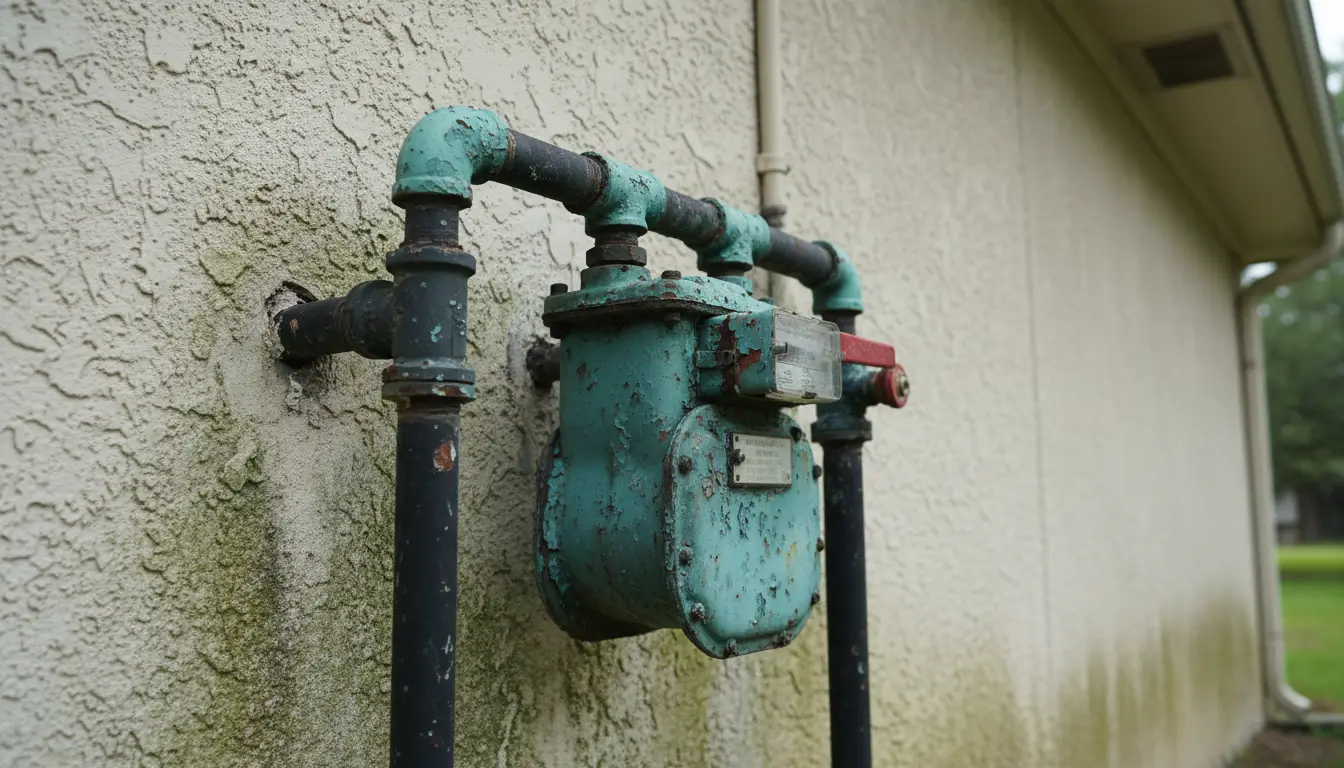
Illustration of the equipment: an exterior gas meter set, regulator and shutoff
How we work a gas line
Gas work on our trucks is journeyman grade or higher, no exceptions, and that is not a marketing line, it is how the crew is staffed. We pressure test and inspect the line in a way that does not compromise the integrity of the pipe itself, so the test tells you something true about the line rather than just about the fitting we just put a gauge on.
Sealing compounds and thread materials are the ones rated for gas, not whatever was in the truck for water work, and every joint gets isolated and proved before it goes back into service. That is the same standard whether it is a new appliance connector inside a house in Groves or a full meter-to-appliance run on a property out toward Bridge City.
Chapter 03
If you can smell gas, do this
Get out, get everyone else out, and do not flip a light switch or strike a lighter on your way. Call us or call your gas utility from outside the house. This is deliberately not handyman work: a bad gas joint does not announce itself the way a dripping faucet does, and the cost of getting it wrong is not a stain on the ceiling.
Once the line is safe, that is when a Texas Master Plumber crew earns its keep, tracing the actual fault instead of guessing at it. We have been doing gas work out of this shop since 1965, and the flat rate for it still comes out of the same book everything else does. Call (409) 226-2451 and tell us what you're smelling and where.
Jim Snell Master Plumber, Texas Master Plumber licences M-256 and M-4740, working Nederland since 1965. Call (409) 226-2451.